
How to Control Dandelions, Ground Ivy and Other Broadleaf Weeds in Pennsylvania Lawns
Every spring, yellow dandelion flowers dot lawns across southeastern Pennsylvania like unwelcome confetti. By summer, ground ivy has crept through shady corners, and clover patches have expanded where turf once grew. Unlike crabgrass that dies with the first frost, these broadleaf weeds return year after year unless you address the root cause; literally.
Quick Answer: When Is the Best Time to Treat Broadleaf Weeds?
Fall (mid-September through October) is the most effective time to control perennial broadleaf weeds like dandelions, ground ivy, clover, and violets in Pennsylvania lawns. During fall, these weeds transport energy reserves to their roots for winter storage, and herbicides applied to foliage travel to the roots along with those reserves, killing the entire plant rather than just burning the top growth. Spring applications (especially May) are your second-best option when weeds are actively growing after flowering.
Why Broadleaf Weeds Are Different from Crabgrass
Broadleaf weed control requires a fundamentally different approach than crabgrass prevention. While crabgrass is an annual that dies each fall and returns from seed, most troublesome broadleaf weeds are perennials that survive for years through root systems, bulbs, or spreading stems. The Rutgers New Jersey Agricultural Experiment Station explains that perennial weeds "may go dormant during certain periods of the year but will persist for many years without intervention" (Elmore, "Broadleaf Weed Control in Cool Season Lawns").
This distinction matters because pre-emergent herbicides, the backbone of crabgrass control, don't work on established perennial weeds. Dandelions, clover, and ground ivy are already rooted in your lawn. You need post-emergent herbicides that kill actively growing plants, applied when the weeds are most vulnerable.
Penn State Extension notes that "broadleaf weeds, such as dandelion and ground ivy, are usually controlled with broadleaf herbicides" and emphasizes that "herbicide applications should be made when weeds are actively growing in the spring or early fall" (Landschoot, "Lawn Management through the Seasons").
How to Identify Common Pennsylvania Broadleaf Weeds
Before reaching for an herbicide, identify what you're dealing with. Different weeds require different active ingredients, and misidentification leads to wasted applications and frustration.
1. Dandelions
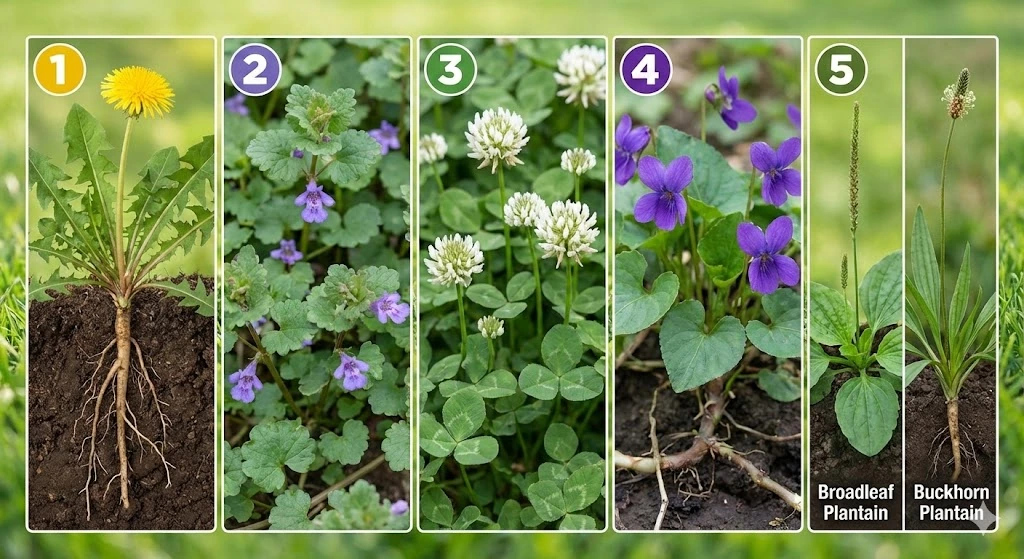
The most recognizable lawn weed forms a rosette of deeply lobed leaves with bright yellow flowers on hollow stems. Dandelions produce taproots that can extend several inches into the soil, making hand-pulling difficult; any taproot fragment left behind will regrow. They flower primarily in spring but can bloom sporadically through fall. The good news: dandelions respond well to most broadleaf herbicide products containing 2,4-D.
2. Ground Ivy (Creeping Charlie)
This low-growing perennial spreads aggressively through creeping stems that root at each node, forming dense mats that smother grass. Look for round or kidney-shaped leaves with scalloped edges on square stems, and small purple trumpet-shaped flowers in spring. Ground ivy thrives in shady, moist areas but can tolerate full sun. Standard 2,4-D products provide poor control; you'll need triclopyr-based herbicides for effective results.
3. White Clover
Identified by its three-part leaves (trifoliates) and white, round flower heads, clover spreads by above-ground runners called stolons. While some homeowners appreciate clover's nitrogen-fixing ability and pollinator value, it can create an uneven lawn texture and dominate thin areas. Clover indicates low nitrogen fertility in your soil. Products containing triclopyr or dicamba provide better clover control than 2,4-D alone.
4. Wild Violet
Heart-shaped leaves and purple spring flowers make violets easy to identify, but they're notoriously difficult to control. Violets spread through seeds and underground rhizomes, and their waxy leaves resist herbicide absorption. Multiple applications of triclopyr-containing products, typically two treatments spaced 2-3 weeks apart, are necessary for meaningful control.
5. Plantains
Broadleaf and buckhorn plantains form rosettes of wide, veined leaves with tall seed stalks. Like dandelions, they have taproots that make hand-removal challenging. Unlike harder-to-control weeds, plantains respond well to standard 2,4-D products found in most retail broadleaf herbicides.
Step-by-Step Broadleaf Weed Treatment
Whether you're tackling a few dandelions or battling a ground ivy invasion, follow these five steps for effective broadleaf weed control.
Step 1: Assess Weed Pressure and Type
Walk your lawn and note which weeds are present and where they're concentrated. Weeds clustering in certain areas often indicate underlying problems: ground ivy in shade, clover in low-nitrogen areas, and knotweed along walkways where soil is compacted. Addressing these conditions prevents reinfestation after treatment.
Step 2: Choose the Right Product
For dandelions and plantains, most retail products containing 2,4-D will work. For clover, ground ivy, and violets, look for products that specifically list these weeds on the label; they typically contain triclopyr or a combination of 2,4-D, MCPP, and dicamba. Rutgers notes that "products that contain triclopyr are much more effective against ground ivy and violets" (Elmore).
Step 3: Time Your Application
Apply herbicides when weeds are actively growing; not during drought stress, heat waves, or dormancy. In Pennsylvania, optimal windows are mid-September through October (best) and May (second-best). Avoid applications when temperatures exceed 85°F, as herbicide volatilization can damage nearby ornamental plants.
Step 4: Apply Correctly
For liquid products, don't mow for 2-3 days before or after application. Longer grass provides more leaf surface for herbicide absorption. Apply when no rain is forecast for 24 hours. Spray coverage must be thorough but not to the point of runoff. Granular "weed and feed" products must be applied to wet foliage (morning dew works well) so granules stick to leaves.
Step 5: Be Patient and Repeat if Necessary
Fall applications may not show dramatic wilting like summer treatments, but the weeds will be gone or significantly reduced by spring. Most tough perennials require repeat applications for complete control, but the interval varies by weed type: clover typically needs two applications 4-6 weeks apart, while violets respond better to treatments spaced 2-3 weeks apart. Ground ivy may require multiple applications throughout the growing season and persistence over multiple years.
Comparing Broadleaf Weed Control Methods
Spot spraying allows you to treat only affected areas, reducing herbicide use and protecting pollinators visiting other parts of your lawn. This approach works best for scattered weed populations and small infestations.
Broadcast applications (treating the entire lawn) make sense when weeds are widespread. Liquid formulations applied through a sprayer generally provide better control than granular "weed and feed" products because coverage is more uniform and the herbicide makes direct contact with leaf surfaces.
Hand-pulling works for small infestations, particularly after rain when roots release more easily. For dandelions and plantains with taproots, you must remove the entire root, or the plant will regrow. Ground ivy and clover spread by runners, making hand removal tedious but possible in limited areas.
Professional applications offer access to commercial-grade products with more effective active ingredient combinations, plus the expertise to identify weeds correctly and time applications properly. For difficult weeds like ground ivy and violets that resist homeowner products, professional weed control programs often deliver better results with fewer applications.
Prevention Tips for Long-Term Broadleaf Weed Suppression
Herbicides control existing weeds, but a dense, healthy lawn prevents new ones from establishing. As Rutgers states plainly, "herbicides should be considered an aid, but not a cure, for broadleaf weed problems in lawns" (Elmore).
- Mow at 3-4 inches: Taller grass shades the soil surface, preventing weed seeds from germinating. Most Pennsylvania cool-season grasses perform best at the higher end of their recommended mowing range.
- Fertilize strategically: Apply nitrogen in fall and early spring when cool-season grasses grow actively but warm-season weeds don't. Avoid heavy summer fertilization that feeds weeds more than your lawn.
- Address thin areas promptly: Bare spots and thin turf invite weed seeds to establish. Overseeding in the fall fills gaps with desirable grass before weeds can colonize.
- Correct underlying conditions: Ground ivy thrives in shade and poor drainage. Clover indicates nitrogen deficiency. Knotweed loves compacted soil. Fix these problems, and weed pressure decreases naturally.
- Reduce soil compaction: Fall aeration improves growing conditions for grass while making life harder for weeds that prefer compacted soils.
When to Call a Professional for Broadleaf Weed Control
Some situations warrant professional help rather than continued DIY efforts.
- Ground ivy or violet infestations: These weeds resist homeowner-grade products and require multiple precisely timed applications of triclopyr-based herbicides. Professional applicators have access to more concentrated formulations and can time treatments for maximum effectiveness.
- Mixed weed populations: When dandelions, clover, ground ivy, and wild violet all appear in the same lawn, no single product controls everything well. A comprehensive weed control program can address multiple weed types with targeted treatments throughout the season.
- Weeds keep returning: If the same weeds reappear year after year despite treatment, either the products aren't reaching the roots or underlying lawn health issues are creating ideal conditions for reinfestation. A professional assessment can identify what's going wrong.
- Lawn renovation situations: When weeds have taken over large portions of your lawn, herbicide alone won't restore healthy turf. You may need a combination of weed control, lawn renovation, and improved maintenance practices working together.
At Greenskeeper Professional Lawn Care Service, Inc, we've been helping Delaware Valley homeowners control broadleaf weeds since 1982. Our lawn care programs include targeted weed control treatments timed to your lawn's specific needs; not a one-size-fits-all schedule.
Take Control of Broadleaf Weeds Before Fall
September and October offer your best opportunity to eliminate dandelions, ground ivy, clover, and other perennial broadleaf weeds. Applications made now travel to the roots where they do lasting damage, setting you up for a cleaner lawn next spring.
For homeowners in Bucks, Montgomery, Philadelphia, and Delaware Counties who want professional-grade weed control without the guesswork, request a free lawn care quote from Greenskeeper. Our programs include fall broadleaf treatments, fertilization, spring weed prevention, and season-long care, with no contracts and free re-treatments if you're not satisfied.
Call us at 215-938-8440 or get your free quote online before the fall treatment window closes.
Sources
- Elmore, Matthew. "Broadleaf Weed Control in Cool-Season Lawns." Rutgers New Jersey Agricultural Experiment Station, FS385, Apr. 2025.
- Landschoot, Peter. "Lawn Management through the Seasons." Penn State Extension.
- Landschoot, Peter. "Weed Management in Turf." Penn State Extension.